
Real-world automations with n8n: integrating WhatsApp, Odoo, and AI
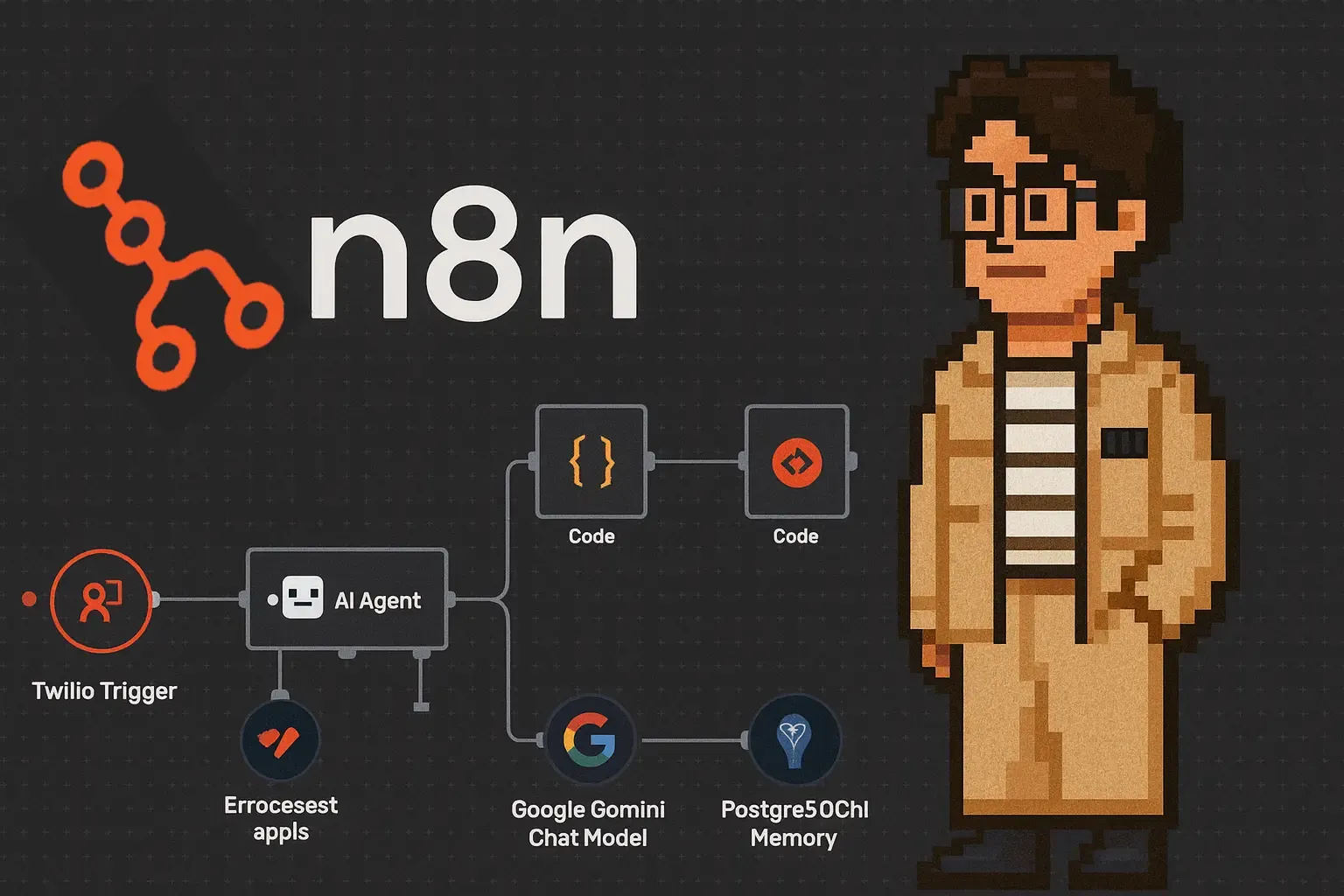
When people talk about n8n, it’s common to find simple examples: a webhook, an API call, or a basic “Hello World” flow to understand how the tool works.
But the true potential of n8n shows up when it’s integrated as part of a multi-layered system, where data from different sources, automated decisions, and real business processes converge. In that context, n8n stops being just an automation tool and becomes an intelligent orchestration platform, capable of interacting with users, interpreting their needs, and triggering tasks without direct human intervention — beyond periodic monitoring and maintenance.
That’s the case I’m sharing here: a flow built from scratch in one workday, connecting Twilio (WhatsApp), Odoo, Google Gemini, and PostgreSQL to shape a bot that doesn’t just respond — it understands, acts, and generates value, even proposing automated quotations based on customer data.
🧠 Real case: automatically replying on WhatsApp based on business logic
This flow was developed in a single intensive workday (approximately 8 hours), with solid prior knowledge of JavaScript and Python, and advance planning on the fundamentals of n8n.
During the process:
- The necessary integrations were researched.
- Credentials for Gemini, Odoo, Twilio, and other services were obtained and configured.
- Technical challenges came up, such as direct webhook implementation, which is tricky in enterprise environments where proxies make hot-testing difficult. This reaffirms that working with a self-hosted n8n environment built from scratch gives you more control and flexibility to tune the server to the project’s needs.
⚙️ The intelligent bot flow
The flow’s entry point is a message received on WhatsApp via Twilio. From there, the following steps run:
- Message preprocessing: Input data is cleaned and adapted.
- AI Agent: Connects to a language model (Gemini, though it can be swapped) to interpret the user’s intent.
- 🔗
Google Gemini 2.5 - 🧠
Postgres Chat Memoryto keep context - 🛠️
Output Structureto ensure the response has a usable format
- 🔗
- Decision making (Switch): Depending on what the AI says:
- An automatic greeting or quick introduction response can be sent
- The case can be evaluated and given the required information in a “support” or similar scenario
- Another system’s database (Odoo) can be queried for relevant data requested by the customer
- Final action: the response is sent via WhatsApp using Twilio. It can also trigger reports, notifications, or information storage.
📚 Why is planning important?
Although the flow, in appearance, responds to a single message, internally it’s designed to capture and process multiple dimensions that influence how it should act:
-
The purpose of the message: identifying whether it’s a general inquiry, an information request, or a team support intent.
-
The state of the conversation: knowing whether the user has been interacted with before, whether there’s stored context, or whether it’s a new conversation that should start a logical thread.
-
The possible outputs of the flow: depending on the previous analysis, it can:
- Generate an automatic response based on the user’s intent.
- Save information in the database as part of a log or CRM.
- Start a quotation flow from Odoo, selecting the best product or service option according to the customer’s message.
On this last point, the system doesn’t just send prices. Thanks to the Odoo integration, the bot is able to analyze which products might be relevant, validate their availability, apply business rules, and finally suggest the most suitable option to the customer with commercial logic behind it, not just technical logic.
All of this was possible thanks to prior planning: we designed a modular structure in n8n, researched compatibility with external services, and defined a clear architecture that could grow without having to rebuild each component from scratch.
Planning was the first step that made it possible to go from an idea to a functional, extensible system in just 8 hours.
🧩 Technologies used
- n8n: the automation core.
- Twilio: WhatsApp input and output.
- Google Gemini: message interpretation.
- PostgreSQL: conversation memory.
- Odoo API: integration to retrieve business data.
- Code Nodes: to control flows and transform responses.
📌 Result
This bot doesn’t just answer: it understands, decides, and remembers.
- It interprets instructions with AI.
- It makes decisions in real time.
- It stores useful data for the business.
- It escalates when it can’t resolve something.
- It notifies about events automatically.
And most importantly: everything was built and tested in a single day, on an environment that allows us to scale later with ease.
📷 Image of the real flow
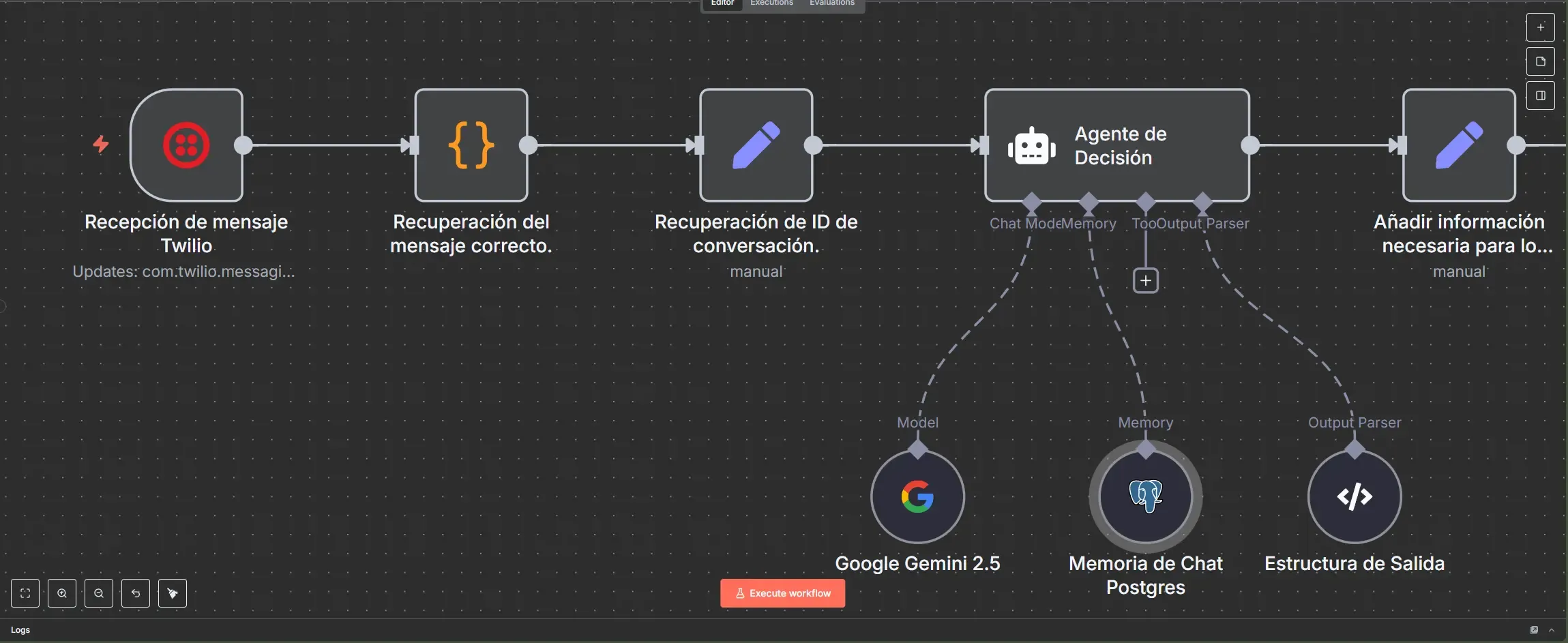
In this flow, multiple tools and nodes are connected to shape an initial automation: the decision-making layer.
✍️ Final reflection
Automating is not just about connecting APIs or simplifying repetitive tasks. It’s about designing a system that understands its environment, keeps context, and acts with judgment about what comes next.
This bot, created in a single workday with solid programming foundations and clear planning, doesn’t just process a message: it interprets it, crosses it with real business data, and makes decisions about what to do — whether that’s escalating a case, storing information, or even generating an advanced quotation from Odoo for a real customer.
Along the way, we faced technical challenges that don’t usually appear in tutorials: like the difficulty of working with webhooks in proxied environments, or the need to adapt servers to gain more control. This confirmed that having an n8n environment configured from scratch is not only viable, but ideal when you’re looking for scalability and flexibility.
This whole flow is just the beginning. What looks like a simple automatic response is, in reality, the entry point to more complex systems, capable of adapting, learning, and generating value without direct human intervention.
It’s not about impressing. It’s about building with intention. And if we do it well, the result will always speak for itself.
🤝 Shall we collaborate?
Are you interested in replicating this kind of flow or exploring how to automate internal processes with tools like WhatsApp, Odoo, or AI?
This project was not an experiment, but a solution applied under real conditions, designed to scale and adapt to different business contexts.
I’m open to:
- Sharing ideas and experiences.
- Advising on the implementation of similar flows.
- Collaborating on projects that seek efficiency, intelligence, and purpose.
📬 If you’re building something in this direction, it will be a pleasure to talk.